Findings & Triage
Managing the vulnerability lifecycle
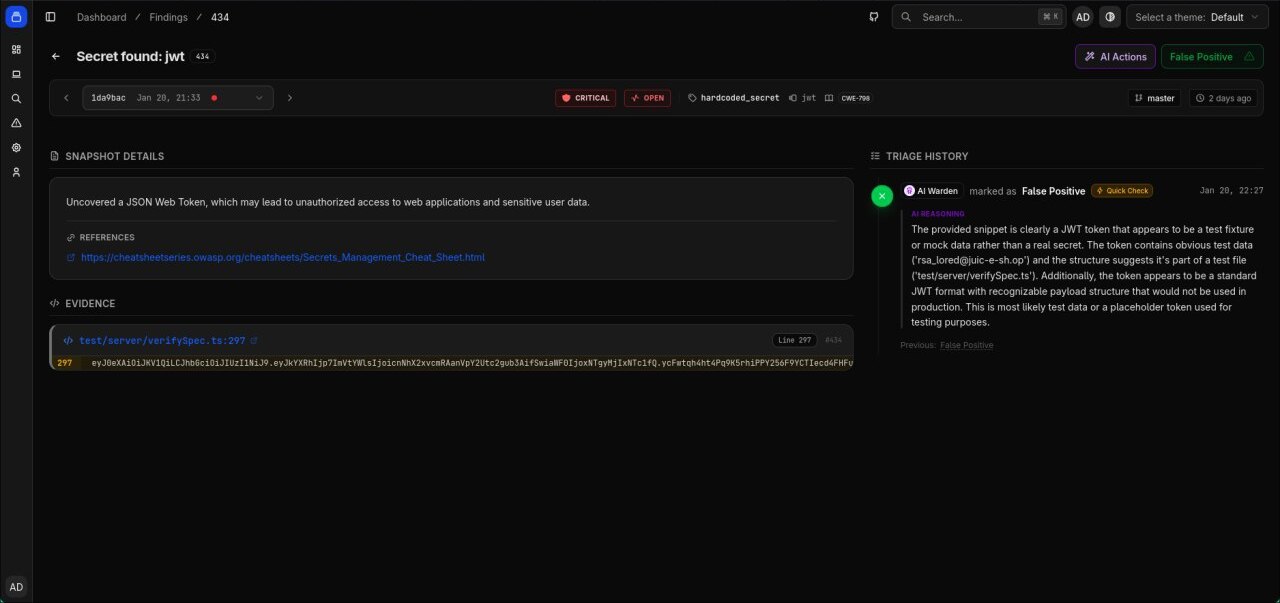
Raw results from tools are normalized into Findings. ScanWarden tracks the lifecycle of a finding across scans, so you don't have to deal with duplicates.
The Fingerprint Concept
Every finding is assigned a unique, deterministic fingerprint. This is calculated based on:
- Rule ID (e.g.,
python.lang.security.injection) - File Path (normalized)
- Structural Hash of the code snippet (ignoring whitespace changes)
This allows ScanWarden to track:
- First Seen: When the issue was introduced.
- Fixed: When the issue disappeared from the codebase.
- Reopened: If a regression occurs.
Finding Clusters
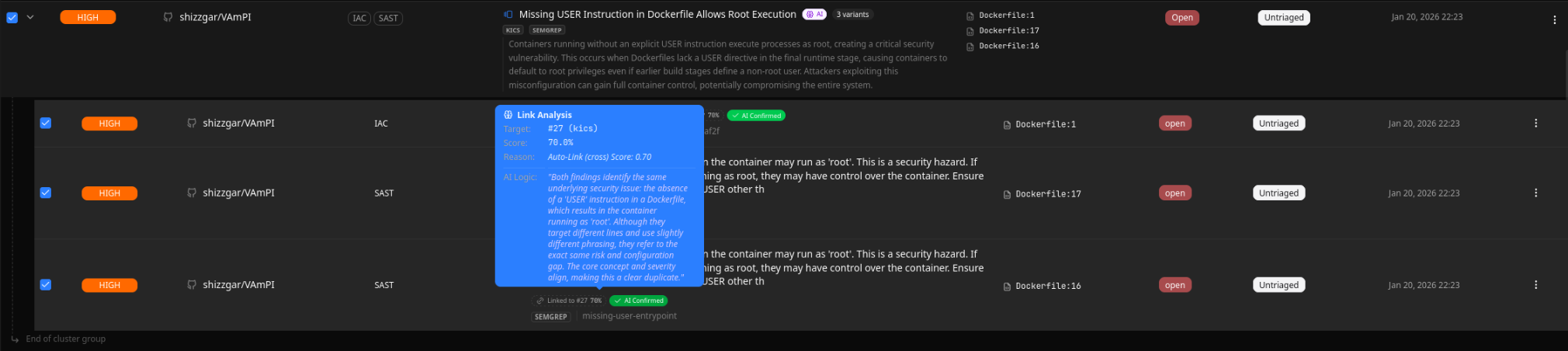
Often, a single vulnerability manifests as multiple alerts (e.g., the same hardcoded secret was detected by different tools).
ScanWarden groups these into Clusters.
Triage Workflow
When you review a finding, you can assign a triage state. This state persists across future scans for the same fingerprint.
| State | Description |
|---|---|
Untriaged | The default state. Needs review. |
Confirmed | A valid vulnerability that needs fixing. |
False Positive | The tool is wrong or the code is safe. |
Accepted Risk | A valid issue, but the business decides not to fix it. |
Suppressed | Hidden by a suppression rule (policy). |